
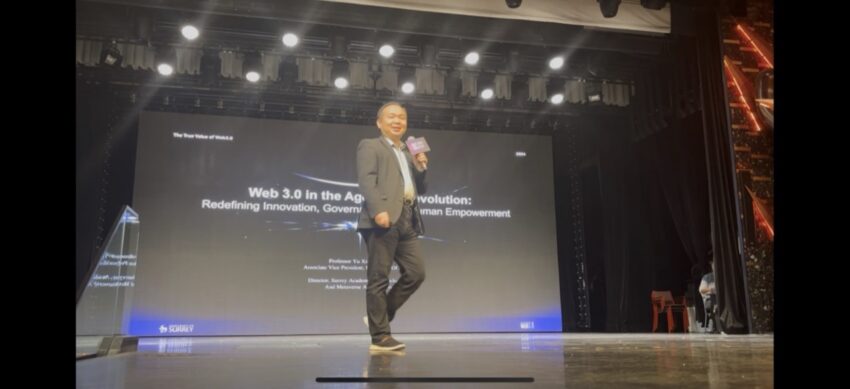
At the Global Digital Sailing Expo and 2024 Web3 Carnival, held on the Costa Serena cruise ship, Professor Yu Xiong, Associate Vice President at the University of Surrey and Director of Surrey Academy for Blockchain and Metaverse Applications, delivered a keynote speech titled “Web 3.0 in the Age of AI Revolution: Redefining Innovation Governance and Human Empowerment.” In his speech, Professor Xiong provided an in-depth analysis of the current chaos within the Web 3.0 domain, noting that while AI is emerging, it has not been effectively utilized in the Web 3.0 ecosystem. Instead, it has exacerbated the turmoil in the space. To address this, Professor Xiong proposed a new vision for redefining Web 3.0.
Professor Xiong emphasized that although Web 3.0 seems vibrant on the surface, it has essentially become a tool for financial speculation. Many projects leverage decentralized finance (DeFi) and non-fungible tokens (NFTs) to attract speculative capital, relying heavily on hype to capture market attention. This has led to a disconnect between users and projects, with interactions centered more on short-term financial gains rather than true value creation. Speculators take advantage of market volatility to reap huge profits, often leaving ordinary users as victims. These users are not empowered to create value, nor do they receive the benefits they deserve. This vicious cycle undermines the original intention of blockchain and diminishes the potential value of Web 3.0, creating negative effects on the industry and hindering its growth.

Professor Xiong further stressed that in the future, while AI may accelerate user creation, it could also steal user creativity. In this context, Web 3.0 must play a key role in ensuring users can create with peace of mind and realize their own value.
Redefining the Development Direction of Web 3.0
To address these issues, Professor Xiong proposed a new development direction for redefining Web 3.0. He emphasized that Web 3.0 should be user-centric, building a decentralized ecosystem that empowers users, protects privacy, and ensures security. True Web 3.0 should grant users complete control over their own data, assets, and digital identities, avoiding becoming merely speculative tools. A co-creation economy should encourage users to actively participate in the ecosystem, driving sustainable innovation and value creation.
Modular Development Mechanism and Serverless Architecture
Building on this, the research team at the University of Surrey has developed a comprehensive framework and introduced a modular development mechanism. Developers do not need to write extensive code or have a deep understanding of blockchain; they only need to combine key components to create Web 3.0 applications. The new protocol adopts a serverless architecture, breaking the limitations of traditional centralized technology, ensuring user autonomy, and protecting privacy. The protocol deploys AI at various levels, staying in sync with the latest technology and features. AI is integrated into the protocol platform to safeguard, supervise, guide its development, and enhance functionality, allowing different technologies to merge seamlessly and provide greater value to users.
Professor Xiong also highlighted a key challenge facing Web 3.0: the fragmented technical standards and development frameworks across various projects and platforms. This incompatibility hinders collaboration and the overall progress of the ecosystem, impacting the wide adoption and scalability of decentralized technology. The new framework enables developers to build interconnected applications across different platforms without worrying about compatibility issues. This not only significantly increases development efficiency but also fosters collaboration and innovation within the ecosystem. This mechanism and philosophy have already been adopted by several development teams, including the upcoming Endless Protocol.
Application Example: Luffa Instant Messaging Software
Within this protocol platform framework, users without programming skills can create applications by assembling components, achieving “plug-and-play” functionality. For example, the fully decentralized and serverless instant messaging software Luffa has already been launched on the Apple Store, where users can download and use it for free.
Industry Response and Future Outlook
Professor Xiong remarked, “Our goal is to lower the entry barrier to Web 3.0, allowing more developers and users to participate. Through modularity and componentization, we hope to build a more open and inclusive decentralized ecosystem.”
His speech garnered widespread attention and lively discussion among attendees. Industry experts believe that Professor Xiong’s views offer fresh insights into the current development of Web 3.0, and the innovative efforts of the University of Surrey’s team are expected to bring positive changes to the industry.
As a key platform for industry exchanges, the Global Digital Sailing Expo and 2024 Web3 Carnival brought together numerous technical experts, industry leaders, and investment institutions. The success of this event is expected to further promote collaboration and innovation in the Web 3.0 field, facilitating the healthy and orderly development of the industry.