
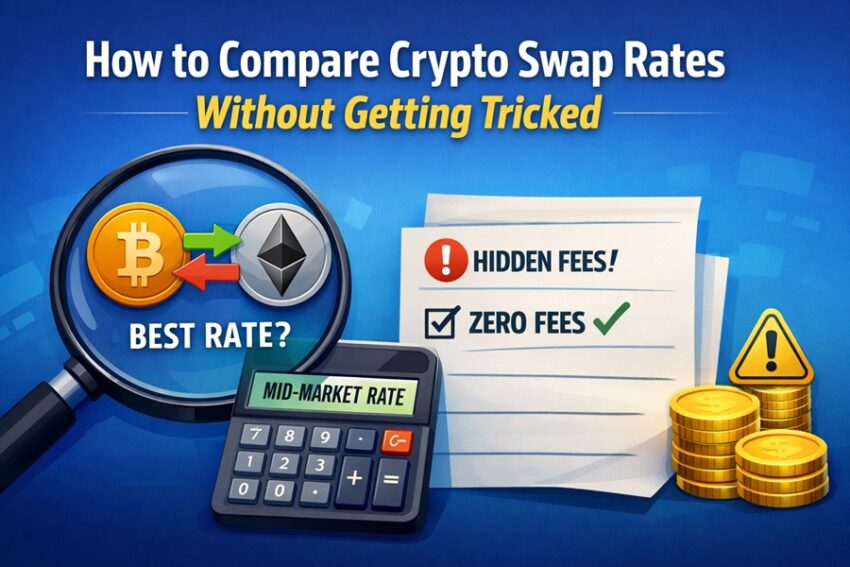
Not every platform that says “best rates” is actually giving you the best rates. Some are. Some are hiding fees in the spread and hoping you don’t check. If you’re going to swap crypto, knowing how to spot the difference takes about 60 seconds and can save you real money.
What You’re Actually Comparing
When you see an exchange rate on a swap platform, that number already includes the platform’s margin. The rate you get is not the same as the mid-market rate you’d see on CoinGecko or CoinMarketCap. It’s the gap between those two numbers that is your real cost.
Some platforms show you the rate and fees separately, so you can see exactly what you’re paying. Others roll everything into one number and call it ‘zero fees.’ That’s technically true in the sense that there’s no separate fee, but the rate itself is worse to compensate for it. You’re still paying. You just can’t see it as clearly.
A Simple Way to Check
Before confirming any swap, do this. Open CoinGecko or CoinMarketCap and look up the current price of the coin you’re sending and the coin you’re receiving. Calculate the mid-market rate. Then compare that to what the swap platform is offering.
On a transparent platform like Paysmaker, the rate and any fees are shown before you confirm, which makes this comparison easy. If the gap between the mid-market rate and the offered rate is under 1.5%, you’re getting a fair deal. If it’s 2-4%, you’re overpaying.
Watch Out for These Tricks
- Zero fees claims. As mentioned above, zero fees usually mean the fee is hidden inside a wider spread. It’s not free. It’s just less visible.
- Bait-and-switch rates. Some platforms show you a great rate on the homepage, but the actual rate at confirmation is different. Always check the final number on the confirmation screen, not the marketing page.
- Ignoring network fees. The swap rate is only part of your total cost. You also pay network fees to send your crypto, and the platform pays network fees to send your new crypto. Some platforms absorb the outgoing network fee, others don’t. Factor this in.
- Rate-shopping obsession. Spending 20 minutes checking five platforms to save 0.1% on a $100 swap is a bad use of your time. Find a platform you trust with consistently fair rates and stick with it for routine swaps.
Fixed and Floating Rates Affect the Comparison
If you’re comparing rates between platforms, make sure you’re comparing the same type. A floating rate on one platform versus a fixed rate on another isn’t an apples-to-apples comparison. Fixed rates include a premium for price certainty. Floating rates are closer to the market but can change before your swap completes.
Compare fixed to fixed and floating to floating. That’s the only way to get a meaningful picture.
One more thing on this. If you’re swapping during a calm market and the amount is small, floating rates will almost always be cheaper because you’re not paying the fixed rate premium. But if the market is volatile and you’re swapping a larger amount, the certainty of a fixed rate is worth the extra cost. Match your rate type to the situation, not to a default habit.
The Bottom Line
Properly checking swap rates takes less than a minute. Look up the mid-market rate, compare it to what you’re being offered, factor in network fees, and make sure you’re comparing the same rate type. Do that consistently and you’ll never overpay for a swap without knowing it.
It’s also worth remembering that the “best” rate isn’t always the most important factor. A platform that consistently gives you fair rates, processes swaps reliably, and shows you exactly what you’re paying before you confirm is worth more than one that advertises the cheapest rate but hides costs in the fine print. Consistency and transparency beat a marginal rate advantage every time.
Get into the habit of checking, and the numbers will start to make sense quickly. After a few swaps, you’ll spot a bad rate instantly without even needing to open CoinGecko.