
Introduction
Blockchain systems are gaining a lot of attention as a tool to increase financial transactions, commerce, and traceability while streamlining supply chains.
A significant portion of this interest was sparked by the speculative craze around Bitcoin, which is built on an outdated blockchain architecture with issues with speed and energy usage.
However, to increase scalability and acceptance, blockchain initiatives are changing along with the rest of the world. We’ll be introducing the new blockchain project HBIT in this article. HashBit now has programmability and interoperability thanks to the cutting-edge HBC20 Chain.
What is HASHBIT?
Created in May 2021, HashBit is a rapidly expanding open-source blockchain. HashBit (HBIT) is a peer-to-peer digital currency that offers industry-leading transaction speeds with very low costs.
HashBit is based on a PoA consensus algorithm that supports quick block times and affordable costs. Staking will create validators and produce blocks from the candidates who have the highest bonding levels. The double-sign detection, together with additional slicing logic, ensures chain finality, stability, and security.
The new blockchain and DEX are designed to provide a decentralised alternative market for the issuance and exchange of digital assets.
History of HASHBIT
HashBit began its adventure in May 2021, when the blockchain completed the genesis block and began transactions. Trading began four months later on Finexbox.com and Bankcex.com, and several features were introduced.
Then, in May or June 2022, the development team introduces the new Portfolio, change the official website, and keep working on creating Blockchain-compatible applications.
The team introduced the HBIT Smart Chain in November 2022.
How does HASHBIT Works?
HashBit, or HBIT, is a cryptocurrency that supports smart contracts and is compatible with the Ethereum Virtual Machine (EVM). The objective of the design was to integrate smart contracts into the HashBit ecosystem while maintaining the high throughput of the system.
Additionally, HashBit supports protocols and smart contracts that are EVM-compliant. Because interoperability is natively supported, cross-chain transfer and other forms of communication are available. Assets on both chains may still be traded on HBIT Exchange in a liquid environment. For consumers to benefit from the quick trade on one side and create their decentralized applications on the other, this dual-chain design would be perfect.
Feature of HASHBIT
The wide range of features available allows you to create infinite applications that work on the Blockchain, in complete safety and decentralization.
HBIT now has a BEP20 token and two Blockchains.
But what features does the HBC20 possess?
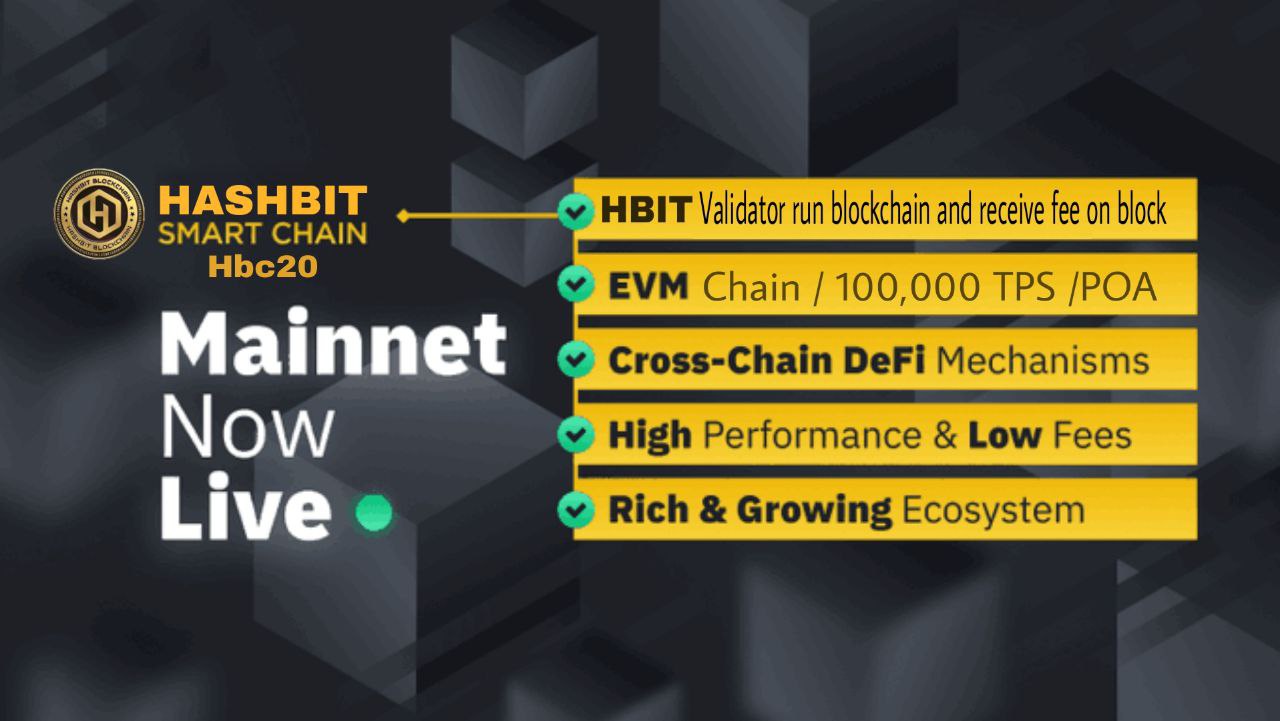
- More than 100,000 TPS is supported.
- POA (Proof of Authority).
- Low Fees.
- Compatible with EVM and Metamask.
- By incorporating Blockchain data, it is compatible with all current wallets.
What Makes HashBit Different From Others?
1. Proof of Stake Consensus
HBIT employs a mechanism for proof-of-stake consensus. The brilliant HBIT proof of stake algorithm has stood the test of time, with no successful assaults in practice since its inception in May 2021. It is dependable and energy-efficient, with low hardware needs.
2. Universal Blockchain Framework
The HBIT Blockchain software is intended to serve as an all-encompassing foundation for the evolving distributed ledger technology. Blockchain adoption is straightforward because of its modular design, which can be expanded to accommodate any public or private use case.
3. Decentralized Asset Exchange
HBIT has a user-friendly asset exchange that is also completely decentralized. On top of HBIT, anybody may create and trade tokens, and orders are matched and carried out immediately on the blockchain.
4. Proven Stability
Since MAY 2021, the HBIT blockchain has been operating in production with almost no downtime, significant issues, or successful vulnerabilities. Millions of HBIT transactions have been completed, solidifying its position as one of the most secure blockchain systems.
About HASHBIT
HBIT is a cryptocurrency that uses open-source Java and is entirely proof-of-stake. HBIT’s exclusive proof-of-stake algorithm is immune to so-called nothing-at-stake attacks and is independent of any implementation of the coin age notion employed by other proof-of-stake cryptocurrencies. The genesis block saw the distribution of 50 billion usable tokens in total. Along with the more popular SHA256 hashing algorithms, Curve25519 cryptography is employed to strike a balance between security and necessary processing power.
On average, blocks are created every 30 seconds. Since there are already enough coins to go around, HBIT is dispersed by adding transaction fees that are given to an account when it successfully produces a block. The present design of HBIT and the block size cap allow for the execution of up to 1,101,600 transactions per day. Transactions are declared secure after ten block confirmations.
HashBit has evolved into one of the most secure, quickest, longest, and most decentralized blockchains in existence.
HashBit (HBIT) was a MultiChain Coin that operated on the HBC20 Blockchain, BEP20 Network, and Native JavaChain.
Other projects can move their tokens to HashBit to benefit from fast transactions, increased liquidity alternatives, and built-in marketplace functionality.
For more information about the projects:
Website: https://hashbit.org/
Documentation: https://docs.hashbit.org