
Cryptocurrency markets have long been associated with dramatic volatility, where prices can rise rapidly but fall just as quickly. While this environment has created opportunities for traders, it has also introduced significant uncertainty. Feather Exchange is proposing a different approach through a mathematically structured trading model designed to guide market growth within clearly defined boundaries.
At the core of the platform’s architecture is a price corridor mechanism that establishes both a minimum daily price progression and a maximum daily expansion limit. Rather than leaving price discovery entirely to unpredictable speculation, the Feather Exchange model introduces transparent mathematical rules that help shape how the market evolves over time.
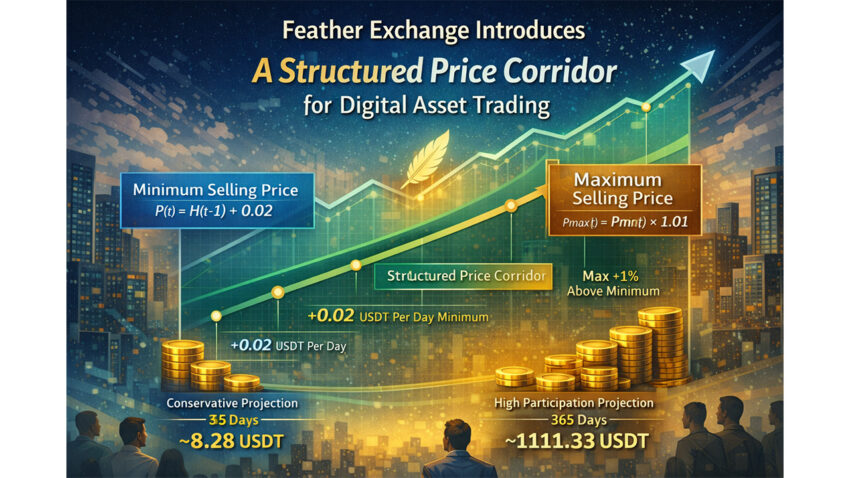
The first component of this framework is the Minimum Daily Selling Price, which is derived from the previous day’s highest executed trading price. The relationship can be expressed mathematically as:
Pmin(t) = H(t-1) + 0.02
where Pmin(t) represents the minimum selling price for the current trading day and H(t-1) represents the highest executed trading price from the previous day. This rule guarantees that the market advances by at least 0.02 USDT per day, creating a structural upward trajectory even during periods of reduced trading activity.
Once this minimum progression level has been established, the market remains free to move higher through normal trading participation. However, to prevent excessive volatility and unsustainable price spikes, Feather Exchange introduces a defined upper boundary known as the Daily Maximum Selling Price. This boundary is calculated as:
Pmax(t) = Pmin(t) × 1.01
This formula ensures that the highest possible trading price on any given day cannot exceed 1 percent above the minimum selling price. Together, these two rules form a controlled trading corridor where the market remains dynamic while maintaining a structured framework for sustainable growth.
Analysts examining this model have also explored its long-term implications using projected scenarios based on the defined mathematical structure. Because the system guarantees a minimum daily increase of 0.02 USDT, the baseline price trajectory follows a linear progression that can be approximated by:
Pn = P0 + (0.02 × n)
where P0 represents the starting price and n represents the number of trading days.
Using this baseline progression model, a starting price of 1.00 USDT would reach approximately 8.28 USDT after 365 trading days, assuming the market only follows the guaranteed minimum daily increase. This represents the conservative scenario in which the market progresses solely through the structural baseline mechanism.
However, the system also allows the price to expand within its daily trading corridor up to 1 percent above the minimum level. In a high-participation scenario where trading activity consistently reaches this expansion boundary, mathematical modeling suggests that the price could approach approximately 111.3303 USDT within the same one-year period.
To illustrate the potential impact of this structure, consider a participant entering the market with 200 USDT at an initial price of 1.00 USDT per FTR, acquiring 200 tokens. Under the conservative progression scenario where the market grows only by the guaranteed 0.02 USDT per day, the value of those tokens would correspond to approximately 1,656 USDT after one year. In the higher-participation scenario where the market consistently approaches the maximum daily expansion boundary, the same position could correspond to a value exceeding 22,000 USDT, based on the modeled price trajectory.
These projections are derived directly from the defined mathematical structure of the Feather Exchange trading framework and illustrate how the interaction between the minimum price progression and the 1 percent expansion ceiling shapes the long-term dynamics of the ecosystem.
As Feather Exchange prepares for its 2026 Shareholder Pre-Launch Event, the platform’s structured price corridor is emerging as one of its most distinctive innovations. By embedding mathematical rules into the trading architecture itself, the exchange aims to create a market environment where growth remains both measurable and sustainable.
In an industry frequently defined by unpredictable price swings, Feather Exchange is advancing a different philosophy: that the future of digital asset markets may lie in systems where carefully engineered economic structures guide the path of long-term value creation.